Hearing noises in your roof? Call our friendly team for expert advice and a FREE phone consultation.

 (03) 9372 2670
Why a Licensed Termite Expert Should Be Part of Every Home Purchase
What Melbourne buyers should know before they bid, sign or settle
The key point: A building inspection and a timber pest inspection answer different questions. Arrange an independent termite inspection early enough for the findings to guide your offer, contract conditions and repair decisions.
Buying a home is one of the largest financial commitments most Australians make. Buyers study sale prices, floorplans, school zones and renovation potential, yet termite risk often receives a brief visual check or a single line in a general building report.
That approach leaves room for expensive surprises. Subterranean termites travel through soil and concealed areas. They feed on cellulose found in timber and other building materials, often behind plaster, under floors, inside skirting boards, around service penetrations or within roof and subfloor spaces. A home might look clean and recently painted while evidence of activity or damage sits out of sight.
Consumer Affairs Victoria advises buyers to consider a professional pest inspection and to obtain their own independent report. It also recommends an inspection service with full professional indemnity insurance undertaken by a licensed pest professional. Those checks matter in metropolitan Melbourne, where buyers encounter older weatherboard houses, renovated period homes, brick veneer properties and newer slab-on-ground construction. None of those building styles removes termite risk because each property still contains vulnerable materials or concealed entry routes.
A building inspection is not a complete termite inspection
A building inspector focuses on the condition of the structure and visible defects. A timber pest specialist focuses on evidence of termites, borers, fungal decay, damage and conditions associated with future attack. The roles overlap, but the training, inspection process and risk interpretation differ.
A quick pest check bundled into another service might cover obvious signs. It might not provide the focused inspection time, specialist equipment or detailed timber pest reporting needed for an informed purchase decision. Before booking, ask exactly what the inspection includes, which areas will be accessed, what standard guides the report and who will perform the work.
AS 4349.3-2010 is the Australian Standard for timber pest inspections. It sets minimum requirements for a non-invasive inspection and the preparation of a timber pest report. A report should also state its scope and limitations. Locked rooms, stored goods, fixed floor coverings, insulation, low-clearance subfloors and other inaccessible areas restrict what any inspector sees on the day.
What “licensed” means in Victoria
Victoria’s Department of Health licenses individuals who operate or are employed by a pest control business and apply pesticides to control pests. A technician treating termites should hold a current pest control licence with authorisation that includes timber pests. The department provides a public register for checking the licence holder’s name and expiry date.
For a pre-purchase inspection, look beyond a licence card. Ask about the inspector’s termite-specific training, field experience, reporting process and professional indemnity insurance. Also confirm who would recommend or perform treatment if activity is found. Strong inspectors explain the evidence, the level of uncertainty and the next investigation required. They do not treat a thermal image or a hollow sound as proof by itself.
One way of ensuring you are engaging a termite inspector who ticks all these boxes is to visit AEPMA.com.au. AEPMA is the peak industry body for the pest and termite professionals across Australia. AEPMA hosts a specialist termite inspector register for which signatories must demonstrate a minimum number of years of experience, minimum cover of $20,000,000 in Public Liability and $1,000,000 in Professional Indemnity insurance. An essential part of AEPMA membership is being licensed and holding adequate insurance coverage. Membership of the industry association also demands ongoing professional development. Specialist inspectors are also signatories to industry-leading best practice Codes of Practice.
What specialised expertise uncovers
Termite inspection relies on a methodical search for small clues and patterns. An experienced, licensed termite inspector examines accessible interiors, roof voids, subfloors, the exterior perimeter, fences, landscaping timbers, trees and other relevant areas. They look for active termites, mud tubes and workings, damaged or softened timber, previous repairs, moisture problems and signs of earlier treatment.
They also read the building as a system, since individual factors combine to determine the overall risk of termite attack. A leaking shower, overflowing gutter, poor site drainage, blocked subfloor vents, timber stored under the house or garden soil built up against external walls all change the risk picture. The Victorian Building Authority advises owners to address plumbing, roof and drainage leaks, keep garden beds and mulch away from walls, avoid storing cellulose materials under the house and maintain subfloor ventilation.
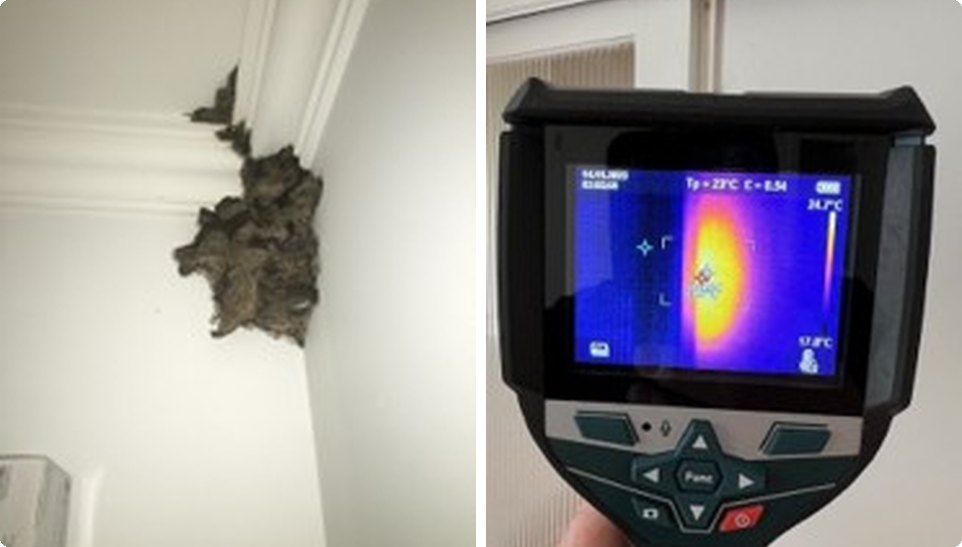
Termite workings visible within an internal wall cavity. Concealed activity often remains hidden during a casual walkthrough.
The tools support judgement, they do not replace it
A thorough inspector brings more than a torch. Depending on the property and access available, the process often includes a moisture meter, sounding or tapping tools, careful probing of suspect timber and thermal imaging. Some termite specialists also use movement-detection equipment in selected areas.
Thermal cameras show surface temperature differences. A warmer or cooler pattern might relate to moisture, insulation, plumbing, air movement or pest activity. Training and follow-up checks are essential because the image does not identify termites on its own. A specialist connects the pattern with physical evidence, moisture readings, building conditions and knowledge of termite behaviour before drawing a conclusion.
Professional termite inspectors may also carry a radar unit such as the Termatrac T3i, which detects movement within a wall and can identify the signature activity of termites in flooring, wall cavities or other concealed areas.
A thermal scan highlights a surface temperature anomaly. The result guides further investigation rather than proving termite activity by itself.
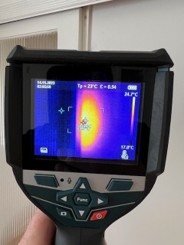
The second scan below shows why experience matters. Subtle variations need context. The inspector must understand the building materials, recent weather, heat sources and moisture pathways, then compare the reading with findings from the rest of the inspection.
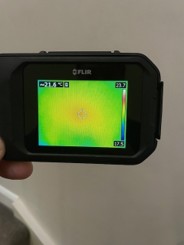
A subtler thermal pattern still requires interpretation and confirmation with other inspection methods.
Termite biology changes the risk assessment
Subterranean termites live in organised colonies and move between the nest, soil and food sources through protected routes. Their mud workings help maintain the dark, humid conditions they need. This behaviour lets them cross concealed gaps and reach timber without remaining exposed for long.
A specialist therefore assesses more than visible insects. They consider where termites might enter, where moisture persists, which timbers remain vulnerable and whether previous termite-management measures remain visible and serviceable. Steel framing does not make a house termite-proof. Termites still attack steel-framed homes because other timber food sources, such as door frames, skirting boards, flooring and cabinetry, remain inside.
Season and weather also affect what appears during an inspection. Swarming activity is easier to notice at certain times, while concealed foraging continues without an obvious surface sign. A lack of visible termites on one day does not equal zero future risk. The report should separate current evidence from conditions that raise the likelihood of future activity.
What a useful pre-purchase report should tell you
A strong report turns observations into decisions. It should clearly record:
- the areas inspected and the areas where access was restricted
- evidence of active termites, previous activity or termite damage
- evidence of other timber pests or fungal decay where relevant
- conditions that favour termite entry or survival, such as moisture, water leaks, high soil levels or timber-to-soil contact
- visible termite-management systems, treatment notices or other signs of earlier treatment or termite activity
- the apparent severity and location of findings
- further investigation, treatment, repairs or specialist assessment recommended
- the inspection limitations and the timeframe for urgent next steps
If the inspector suspects structural damage, seek advice from a suitably qualified building professional or structural engineer. A termite inspector identifies pest evidence and associated damage. They do not replace an engineering assessment of load-bearing capacity.
Use the findings before you commit
Timing matters. For a private sale, discuss an appropriate building and pest condition with your conveyancer or solicitor before signing. The wording and deadlines need to protect your position and suit the contract. For an auction, arrange the inspection before bidding because a successful auction purchase is usually unconditional.
When termite activity, damage or high-risk conditions are reported, the findings support a practical response. Depending on the evidence and contract, buyers might seek further investigation, treatment details, repair quotations, a price adjustment or a decision to withdraw. Consumer Affairs Victoria notes that an independent inspection report assists with price and contract negotiations and helps buyers plan future maintenance and negotiate with vendors.
If live termites are found: Do not spray them, break open the workings or remove damaged material before professional assessment. Disturbance might scatter activity and make the source harder to evaluate. Keep the area intact and follow the termite specialist’s instructions.
Questions to ask before appointing an inspector
- Qualifications and experience: What termite-specific training does the inspector hold, and how often do they perform pre-purchase timber pest inspections?
- Victorian licence: If treatment is recommended or supplied, does the technician hold a current licence authorising timber pest work?
- Insurance: Does the inspection business hold current professional indemnity and public liability insurance?
- AEPMA membership: Is the inspector a member of AEPMA, the industry’s professional association?
- Standard and scope: Will the inspection and report follow AS 4349.3-2010, and which parts of the property are included?
- Equipment: Which tools will be used, and how will findings from thermal imaging or moisture readings be confirmed?
- Access: Will the roof void, subfloor, exterior perimeter and relevant site timbers be inspected where safe and accessible?
- Reporting: When will the written report arrive, and will the inspector explain urgent findings directly?
Why the cheapest inspection is rarely the best value
The fee for a focused termite inspection is small beside the price of a Melbourne property and the disruption of opening walls, replacing damaged timber or arranging treatment after settlement. The real value sits in the quality of the inspection, the clarity of the report and the decisions it supports.
A low-cost report with broad exclusions, rushed access and little explanation offers limited protection. A qualified termite professional documents what they saw, which areas they were unable to inspect, why each finding matters and what you should do next. That detail gives you a defensible basis for your purchase decision.
Book a Melbourne pre-purchase termite inspection
Noah’s Ark Pest Control provides pre-purchase termite inspections across metropolitan Melbourne. The family-owned team is fully licensed and insured, with more than 20 years of pest management experience. Its termite specialists use a combination of practical inspection methods and detection technology, then provide a detailed written report to guide your next step.
Before you bid or sign, speak with Noah’s Ark Pest Control on (03) 9372 2670 or book a pre-purchase termite inspection online.
Fact-check sources and further reading
The following authoritative sources support the inspection, licensing and termite-risk guidance used in this article:
- AEPMA.com.au
- Consumer Affairs Victoria, Inspect properties before you buy
- Victorian Department of Health, Find a licensed pest control operator
- Victorian Building Authority, Termites
- Victorian Department of Health, Pest control: termites
- Standards Australia, AS 4349.3-2010: Inspection of buildings, Part 3: Timber pest inspections
- FLIR, Detecting pests with thermal imaging
- Noah’s Ark Pest Control, Pre-purchase termite inspections Melbourne