It’s Termite swarming season. Call our friendly team for expert advice and a FREE phone consultation
 (03) 9372 2670
Why Termites Lose Their Heads: What Happens Inside a Baited Coptotermes Colony
Open a termite bait station a few weeks into a successful treatment and you might see something unsettling: termites heads. Heads scattered through the bait, bodies missing, while their nestmates carry on working around them. It looks like a crime scene. In fact, it's one of the best signs we can get that the colony is heading for collapse.
Here's what's going on, and why it matters if you're having a baiting program treating your home.
Meet Coptotermes, Australia's most destructive termite
Coptotermes are subterranean termites. In Victoria and across much of southern Australia, Coptotermes acinaciformis is the species responsible for a large share of the serious structural damage we see. Colonies can run into the hundreds of thousands, or even millions, of individuals, hidden underground or inside trees, stumps and wall cavities.
That hidden, enormous colony is exactly why baiting works so well. Rather than trying to find the nest, we let the termites carry the treatment home themselves.
How termite baits actually work
Modern termite baits use an Insect Growth Regulator, active ingredient called a chitin synthesis inhibitor (CSI). Chitin is the material insects use to build their exoskeleton. Every worker termite has to moult regularly, shedding its old skin and forming a new one underneath.
A CSI doesn't kill a termite straight away. Instead, the termite eats the bait, returns to the colony, and shares it with nestmates through mouth-to-mouth feeding (trophallaxis). Nothing happens until each termite tries to moult. Then the new exoskeleton forms incorrectly, and the termite can't complete the process.
That slow action is deliberate. Because termites aren't dropping dead at the bait station, the colony doesn't learn to avoid it. Research on Coptotermes has shown that a colony can pick up a colony-wide lethal dose surprisingly quickly once it starts feeding, and Australian field trials on C. acinaciformis have shown whole colonies eliminated within weeks to a few months.
A failed moult and an unwanted guest
We observed baited Coptotermes workers trying to moult. What they saw explains much of the behaviour we find in the field:
- The affected termites start the moult normally, but their muscle contractions are weak and the old skin never splits open properly.
- The new cuticle underneath is grainy and porous. When the muscles pull against it, it tears.
- The termite effectively bleeds out, leaking body fluid while still trapped in its old skin.
- Moribund termites lie mostly still, groomed now and then by nestmates, until the leaking fluids trigger cannibalism.
It is also noted that: affected termites often turn a creamy white colour in the abdomen from a build-up of uric acid. That chalky, "marbled" look is another sign we watch for in stations.
Why the heads come off
Termite colonies are fanatical about hygiene. A dead or dying nestmate in a crowded underground nest is a disease risk, so termites have evolved what scientists call undertaking behaviour. Studies across several subterranean termite species, including Coptotermes, show workers respond to sick or dead nestmates by grooming, alarm signalling, burying or eating them, depending on how fresh the body is and what killed it.
Fresh corpses and dying nestmates are usually recycled by being eaten. Nothing is wasted in a termite colony. The body is protein and nitrogen, both scarce on a wood diet.
The head is the hardest part of any termite, and none is tougher than a soldier's. A Coptotermes soldier's head is a heavily armoured, amber-coloured capsule built around its large mandibles and the gland it uses to squirt a sticky white defensive fluid. Workers eat the soft body and leave the head behind.
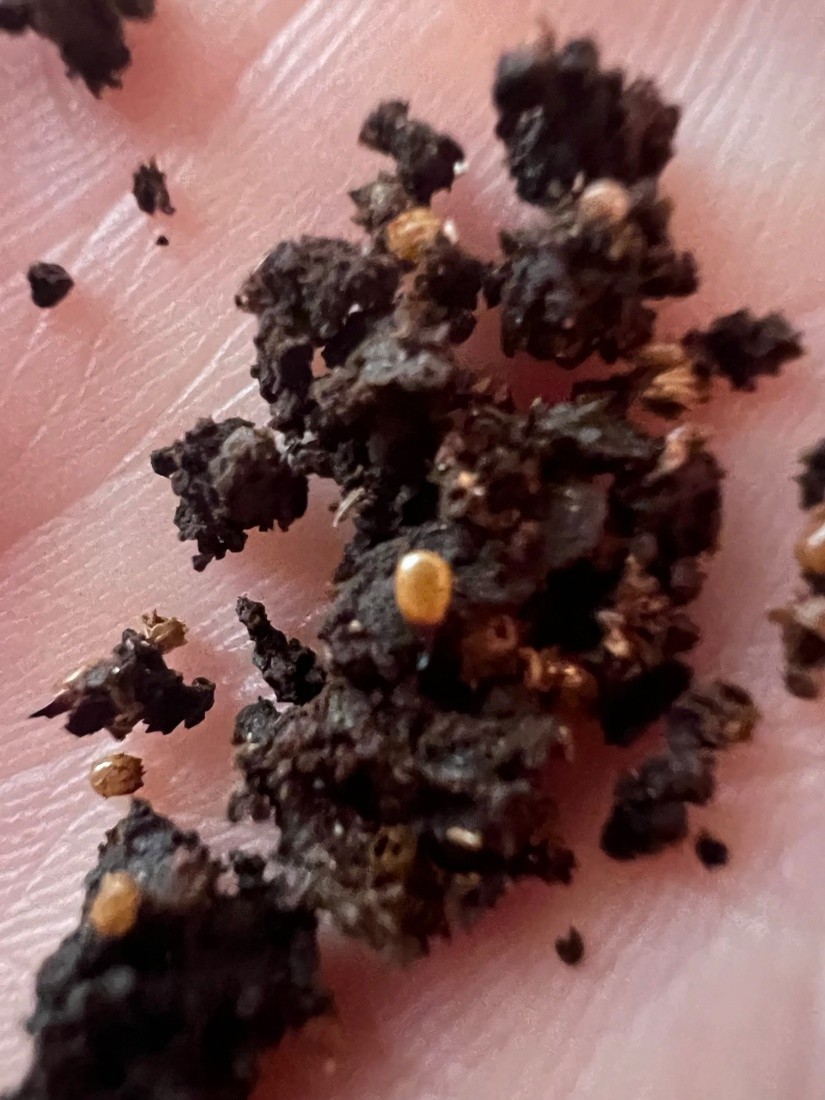
In our own bait stations, this is exactly what we find: small, golden, teardrop-shaped soldier heads scattered through the bait and soil, with no bodies attached.
Coptotermes soldier heads left behind in one of our baited stations. The amber, teardrop-shaped capsules are all that remain once the workers have eaten the bodies. Photo: Noah's Ark Pest Control.
Why soldiers? Soldiers can't feed themselves. They depend entirely on workers to feed them. As the bait works through the workforce, the soldiers are left starving and weak, and the remaining workers recycle them for food. The armoured head is simply too hard to be worth eating, so it gets left behind as a calling card.
There's a nice twist here. Cannibalism is itself another route for bait to move through the colony. When healthy workers eat their dying nestmates, they pick up more of the active ingredient. The colony's own clean-up routine helps finish the job.
Why the colony never sees it coming
Termites are cautious. If dead nestmates start piling up near a food source, they will often seal off the area and forage somewhere else. That's one of the main reasons baits are designed to work slowly.
Research on subterranean termites has shown that workers go back to the central nest, near the queen and the brood, to moult. So when a baited termite fails its moult, it dies deep inside the colony, not at the bait station. The bodies, and the soldier heads, build up where the colony lives, while the bait station still looks like a safe place to feed. In one laboratory study, so many dead built up that the king and queen kept moving from chamber to chamber to get away from them. Researchers even found a dead queen with legs missing from excessive grooming by workers.
Compare that with a liquid termiticide. In a study of whole Coptotermes colonies, liquid termiticides killed every termite within 1.5 metres of the treated zone within two weeks. That's exactly its job: stop termites at a barrier. But the bodies that piled up made the surviving termites avoid the area, and the colony, depending upon the species can continue elsewhere. Colonies given noviflumuron bait showed no change in foraging for about 40 days, then gradually went quiet across their whole territory. Every one was eliminated by 95 days.
Neither approach is better in every situation. Barriers protect the building, and baits target the colony. Plenty of properties benefit from both, and a good technician will explain what suits yours.
No new generation
The bait doesn't only affect workers. A 2021 study on Coptotermes found that queens exposed to a chitin synthesis inhibitor laid fewer eggs, and the eggs they did lay failed to develop. Those eggs were then eaten by the colony too.
That matters because a termite colony normally replaces its workforce constantly. Once the queen's eggs stop hatching, there's no new generation to replace the workers dying at each moult. The soldiers, who rely on workers for every meal, starve. The colony collapses from the inside, and the soldier heads we find in stations are among the last signs of it.
How long does it take?
Less bait, and less time, than many people expect. Researchers gave whole laboratory colonies of around 59,000 Coptotermes access to bait for just one day. Colonies that ate as little as 1.1 grams were still eliminated within 90 days, because the dose had already been shared through the colony.
Australian field work tells a similar story. In CSIRO trials on mound-building Coptotermes acinaciformis in northern Australia, 10 of 12 baited colonies were eliminated or dying within eight weeks. Mound temperatures dropped after about three weeks as the colonies lost their metabolic heat.
Every property is different. Country and even territory, colony size, weather, time of year and how undisturbed the termites are all affect timing. That's why we keep checking your stations regularly until activity has stopped.
What this means at your property
When our technicians check your bait stations, decapitated and dismembered termites are one of several signs we use to judge progress:
- Headless or dismembered termites in the station, often alongside sluggish workers.
- Creamy or marbled workers that look pale and unwell.
- Rising soldier ratio, because soldiers don't moult the same way and are often the last left standing.
- Bait consumption slowing, then termites disappearing from the station altogether.
Please resist the urge to open stations yourself or disturb termite activity in the house. Baiting depends on a steady stream of termites feeding without interruption. Disturbance can cause them to abandon a site before they've taken enough bait.
The bottom line
Headless termites can look alarming, but in a baited colony they're good news. They tell us the chitin synthesis inhibitor is reaching the colony, termites are failing to moult, and the colony's own housekeeping is spreading the treatment further. Within weeks to months, the colony collapses from the inside.
If you'd like to know more about termite baiting, or want a bait system installed or checked, get in touch with the team at Noah's Ark Pest Control.