Hearing noises in your roof? Call our friendly team for expert advice and a FREE phone consultation.
 (03) 9372 2670
Termite vs Ant
# Ants or Termites?
A Melbourne Homeowner's Guide to Telling Them Apart
It's a warm, humid evening in Melbourne when, suddenly, thousands of winged insects are swarming around your house lights and windows and crawling through every gap they can find. Your first instinct might be to grab the surface spray and go to town. A word of caution before you do: take a closer look first, because what you're seeing could be one of two very different pests, and the risks could not be further apart.
Black house ants are a common household nuisance. Subterranean termites are one of the most financially devastating timber pests an Australian home can face. To an untrained eye, particularly when both are in their winged "swarming" stage, they can look remarkably similar. Knowing how to tell them apart is valuable pest knowledge for a Melbourne homeowner to have.
Why the confusion?
Both ants and subterranean termites produce winged reproductive members, known as alates or swarmers. One key difference is the time of year the swarming occurs. Both insects leave the nest at a particular point in their lifecycle, biologically equipped to reproduce, with the trigger for swarming usually being a change in weather.
Termites have a defined lifecycle, and in Melbourne we typically see swarmers released between November and March. Termite swarming events tend to happen on a warm, humid evening, often after rain, which in Melbourne usually means late spring through to late summer.
When you see a swarm of small, dark, winged insects, it's difficult to say at a glance whether you're looking at harmless ants or destructive termites. This is exactly why so many homeowners get it wrong, and why termite infestations so often go undetected until serious damage is already done.
The good news is that ants and termites have several clear physical differences. Once you know what to look for, you can usually tell them apart with confidence.
A termite swarm can be a confronting sight. For anyone who hasn't encountered it before, it can feel like something out of an Alfred Hitchcock film, sometimes hundreds, even thousands, of winged termites circling the lights. Although they are technically termites, swarmers have evolved to focus on reproduction rather than foraging for food. The signs of an impending swarm are subtle: small dabs of dirt or mud begin appearing on plaster walls or timber. Then, when humidity reaches dew point, that temperature shift becomes the trigger for the swarm.
The three-second identification test
If you can get a close look at one of the insects, a magnifying glass or your phone's camera zoom helps, check these three features:
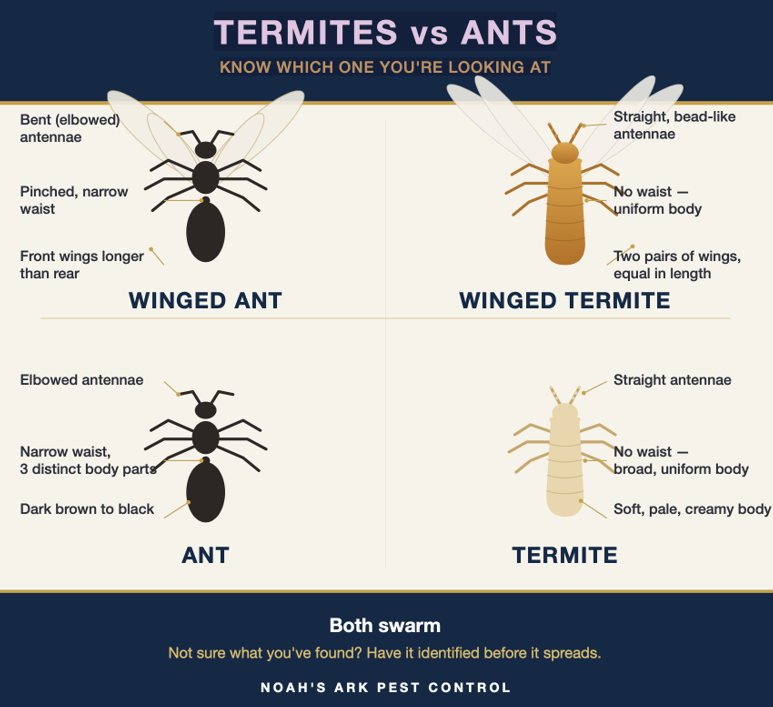
| Feature | Black House Ant | Subterranean Termite |
|---|---|---|
| Waist | Narrow, pinched "wasp waist" between thorax and abdomen | Thick and straight, no obvious pinch; the body looks like a single broad tube |
| Antennae | Bent or "elbowed", with a distinct angle | Straight and beaded, like a tiny string of pearls |
| Wings | Two pairs of unequal length, front wings clearly larger than the back pair | Two pairs of equal length, both longer than the body |
| Colour | Shiny black or very dark brown | Pale, creamy white to light brown in workers; swarmers are darker, commonly brown, though colour varies by species |
The Ant waist is usually the giveaway. Ants have that classic hourglass figure; termites are straight up and down. And if you find discarded wings around windowsills or skirting boards, termites may be the culprit given they shed their wings after swarming, leaving little piles behind. Discarded wings is a red flag pointing to termites rather than ants
Meet the black house ant
The black house ant (Ochetellus glaber) is one of the most common household ants across Melbourne and Victoria. They're small, around 2.5 to 3mm, shiny black, and you'll typically see them forming trails along benchtops, around pet bowls, near rubbish bins, and anywhere food and moisture are available.
Black house ants are primarily a nuisance pest, although some species are more invasive than others. Carpenter ants, for example, will invade wall cavities and can occasionally cause problems where they nest around electrical wiring.
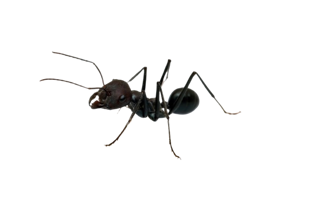
Depending on the species, ants are attracted to sweet foods, moisture and proteins. While they can contaminate food and are simply unpleasant to have marching across your kitchen, they do not structurally damage the timber in your home. A persistent infestation usually points to an accessible food source, a moisture problem, or a nest somewhere in or near the building's perimeter. Ants are often most active in spring, as part of their breeding cycle, and again in autumn before they settle into winter dormancy.
They're frustrating, but they are not typically structurally damaging.
Meet the subterranean termite
Subterranean termites are a completely different proposition. In Victoria, the species of greatest concern is Coptotermes acinaciformis, regarded as the most economically destructive timber pest in Australia and responsible for around 80% of severe damage in homes. This species lives in very large colonies, often 500,000 members or more, frequently establishing their colonies within the root system of a large native tree, and will travel up to 100 metres from the colony in search of timber, which it consumes for the cellulose it contains. CSIRO data indicates that homes in Victoria face up to a 30% risk of a termite incursion, so early identification is key to minimising damage and financial loss.
These termites nest below ground, hence the name subterranean, and forage through hidden mud tunnels. They can be active inside a home's structural timbers for months, or even years, before any visible signs appear.
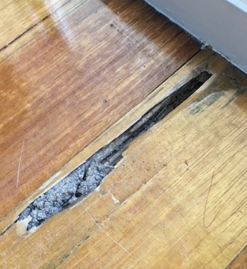
Signs that you may have a termite incursion include the hollowing out of timber components such as a doorframe, window frame or architrave; a rippling effect across the surface of timber flooring; and what looks like water staining but is actually the moisture termites generate to keep their environment damp. By the time damage is visible, the incursion may already be extensive in concealed areas such as the subfloor, wall cavities and roof voids.
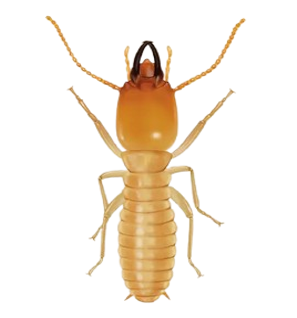
This is what makes termites so insidious: they harbour out of sight, and by their very biology they are working 24 hours a day.
Importantly, termite damage is not typically covered by home and contents insurance in Australia. The cost of termite treatment and associated repairs is the homeowner's responsibility, which is precisely why prevention and early detection matter so much. Early detection will often mitigate structural damage, and one of the best ways to manage that risk is to engage a termite expert to conduct a regular annual termite inspection. An annual frequency is recommended because, particularly in Victoria, we would not typically expect to see structural damage develop within 12 months of an incursion.
Warning signs of subterranean termites
Unlike ants, which you'll usually see foraging in the open, termites give themselves away through subtler clues. Keep an eye out for:
- Mud tubes, pencil-width tunnels of soil and saliva running up brick foundations, walls, piers, or subfloor timbers. These protect termites from the open air as they travel.
- Hollow-sounding timber, tap skirting boards, door frames and architraves. If they sound papery or hollow, termites may have eaten the timber from the inside out, leaving only a thin shell.
- Sagging or blistering, floors that feel spongy, paint that bubbles, or door and window frames that suddenly stick.
Discarded wings, small piles of identical wings near windows, doors or light sources after a warm, humid evening.
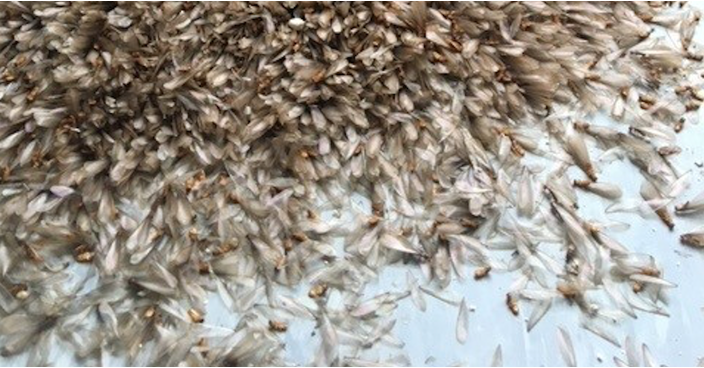
- Discarded wings from a termite swarm
- Dabs of dirt on plaster walls, typical of subterranean termites occupying a wall cavity. Termites need a temperature-controlled, moist environment and insulate themselves with mud, or "mud tubes". Where there is a constant source of moisture, they can establish large bivouacs or sub-colonies within a cavity.
- Noise – Sometimes homeowners may notice a soft tapping sounds almost like a ‘popping’ sound in the wall. This can be Termites, the soldier Termite caste have a unique way of communicating and will bang their heads to communicate danger to others in the colony or when they have found a food source.
If you notice any of these warning signs, it is essential that you avoid disturbing the area in any way. Do not spray it, and do not break open mud tubes. Disturbing an active termite colony can cause them to retreat, scatter and relocate within the structure, making detection and treatment harder and putting other areas at risk. The identification and management of termites is a specialised discipline. If you notice these signs or suspect their presence, it is imperative to contact a termite professional.
Why Melbourne homes are at risk
There's a persistent myth that Melbourne's cooler climate makes termites less of a concern. This is simply not the case. Subterranean termites are well established across greater Melbourne and throughout Victoria, and several factors common to local homes increase the risk.
Some of these are geographical. Close proximity to a train line, river, parkland, or certain street and native trees, peppercorns among them, creates ideal termite habitat.
Others are within your control:
- Moisture. Termites need moisture to make their mud. Leaking pipes, poor drainage, blocked weep holes and air-conditioning runoff all create perfect conditions near your foundations.
- Timber in contact with soil. Termites feed on timber, so landscaping sleepers in garden beds against the house, stored firewood, old stumps, mulch and timber retaining walls all provide easy access points, and a ready food source. It's a little like putting bait out for them.
- Mature trees. Termites favour certain trees for their colonies. Gardens with large mature eucalypts or peppercorn trees, common across many of Melbourne's older suburbs, can harbour colonies close to the home.
- Damp subfloors. The subfloors of the period homes found across much of Melbourne offer the dark, undisturbed, humid environment termites love. Keeping a subfloor dry and free of damp, leaks and clutter helps reduce your risk.
Risk varies from suburb to suburb, and even from property to property, depending on soil type, landscaping, building construction and moisture management. No Melbourne home should be assumed safe simply because of its location.
What you should do
If you've found ants, effective treatment usually involves identifying the nest and food sources, applying targeted baiting or treatment, and addressing the conditions attracting them. It's manageable, and the consequences of getting it slightly wrong are minor.
If you suspect termites, the single most important step is to act early and get a professional assessment. Annual termite inspections by a licensed technician are widely recommended for Australian homes, and in many cases are essential to keeping builder and treatment warranties valid. A professional inspection can detect activity long before you'd ever notice it yourself, and a well-designed termite management system can protect your home for years.
The difference between these two pests really does come down to this: with ants, a delay costs you a clean kitchen. With termites, a delay can cost you your home's structural integrity, and thousands of dollars in treatment and potential repairs.
Not sure what you're looking at?
If you've found winged insects, mud tubes, or timber that doesn't sound right and you're not certain what you're dealing with, the safest move is to have it identified by a professional rather than guess. Misidentifying termites as "just ants" is one of the most expensive mistakes a homeowner can make.
Noah's Ark Pest Control provides professional termite inspections and pest management across Melbourne. If you have concerns, have seen something that worries you, or would simply like the peace of mind of an annual termite inspection, get in touch with our expert team.
Early detection is always cheaper than repair.