Hearing noises in your roof? Call our friendly team for expert advice and a FREE phone consultation.
 (03) 9372 2670
Possum or Rat in the Roof?
That scratching, thumping or scurrying sound in your ceiling at night is one of the most common reasons Melbourne homeowners contact Noah's Ark Pest Control. The noise is unsettling, sleep becomes difficult, and it's natural to worry about what's happening above the ceiling.
Before any treatment starts, there's one critical question to answer: is the animal a possum, a rat, a mouse, or some combination of pests?
Possums and rodents both move into Melbourne roof cavities because they offer warmth, shelter and protection, and they can occupy the same roof at the same time. Possums and rats will readily cohabit a roof void, each using a different section or nesting spot, which is why homeowners often assume they're dealing with one problem when they're actually dealing with two. A possum might nest in one corner while rats move through the insulation and wall cavities nearby, and treating the noise as a single problem is one of the most common misconceptions.
Why an accurate diagnosis matters
Possums and rodents require completely different control methods. Rats and mice are introduced invasive pests. Possums are protected native wildlife and must be managed in line with Victorian Wildlife laws.
Getting it wrong can make things worse. Sealing an entry point while an animal is still inside can trap it in the roof, where it may damage plaster, wiring or roofing materials trying to escape, or die inside the cavity and create a serious odour and hygiene problem.
A professional will looks past the noise itself, consider the physical evidence and assess timing of noises, movement patterns, droppings, nesting material, entry points, roof damage, and physical tracks left around the property to form a professional opinion.
It's a common misconception that only older weatherboard homes are vulnerable to possums. In reality, modern townhouses and newer builds have their own weak points, gaps around eaves, party walls, service penetrations and roofline junctions, and possums are just as skilled at finding and widening these as they are with older construction.
Quick comparison: possum vs rat
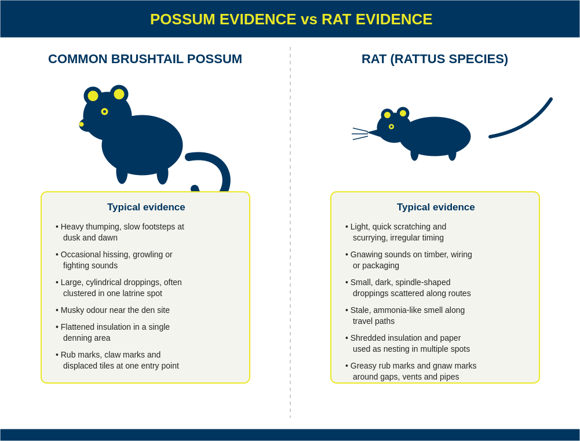
Before the detail, here's a fast visual reference for the noise and evidence differences most homeowners notice first.
Which possum is in your roof? Brushtail vs ringtail
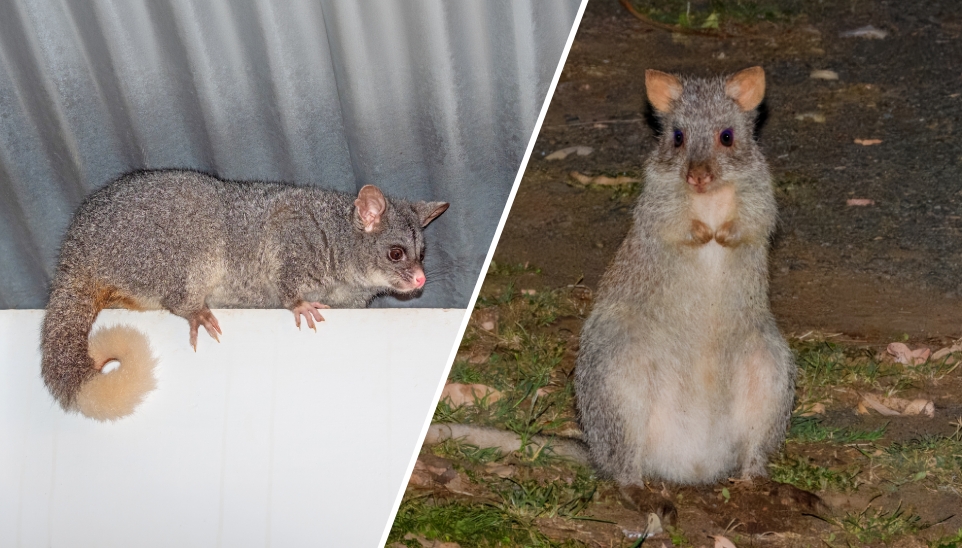
Melbourne is home to two possum species, and the distinction matters for both diagnosis and treatment. The common brushtail possum is typically the most common species that actually gets into roof cavities. It's a larger animal and being a solitary, territorial marsupial it is capable of forcing it’s way through broken tiles, open eaves and gaps around flashing, then dens directly in the ceiling space, insulation or wall cavity, which is why brushtails account for the large majority of roof callouts.
The common ringtail possum is smaller, generally more timid, and less common in roof cavities They generally prefer building a drey, which is a rounded nest of shredded bark, dried leaves and twigs, in a tree fork, dense shrub or thick vine close to the roofline. If you notice dried leaves and twigs poking out of a roof gap, gutter or eave, that's a strong sign of ringtail nesting in your roof. Ringtail possums have survived remarkably well in many inner-city suburbs, where overhead powerlines give them immunity against ground dwelling predators. As a result, we see some suburbs with a very large populations of ringtail possums all competing for dwindling habitat. It is often in these scenarios we find ringtails nesting in roofs.
Ringtail possums also pair for life and often share a drey or den with their mate, along with that season's joeys. Ringtails will also commonly have twins, so this means that where brushtails usually turn up as a single animal, ringtail activity around a property often means two adults and sometimes two joeys are involved, which is worth knowing before any exclusion work begins, since a one-way device installed for a single occupant may not account for a breeding pair moving in and out at different times.
Both species are protected in the same way under Victorian law, but the practical approach differs. A possum in the roof calls for the one-way exit and roof-proofing process described below. Ringtails often require a more detailed analysis of vulnerable points given they are a smaller animal and able to squeeze into considerably smaller gaps.
How to tell a possum from rats or mice by sound
The noise itself often provides the first clue. Possums are creatures of habit: possums typically leave shortly after dusk and returns before dawn, producing a heavy thump, a slow walk across ceiling joists, a burst of scratching, or a loud landing on the roof. Hissing, growling and occasional fighting sounds also point to possum activity.
Rats and mice behave differently. Their movements are lighter, faster and less predictable, often sounding like repeated scratching, scurrying or gnawing at irregular intervals through the night, and sometimes during the day once an infestation is established.
Size matters too. A possum is roughly cat-sized, so its movement carries weight. A rat sounds quicker and sharper, while a mouse tends to produce faint rustling or tapping inside walls and insulation.
Timing is a useful clue but not a definitive one, since a disturbed possum can move during the day and rats can become active around dusk. The most reliable diagnosis combines noise, footprints and physical evidence together.
Other signs around the home
Only look for signs inside the roof if access is safe. Otherwise, inspect from ground level and leave roof access to a trained technician.
- Possum access routes: displaced roof tiles, damaged eaves, and greasy rub marks (fur) near a regular entry point, often reached via nearby branches, fences, pergolas or downpipes.
- Rodent access routes: small gaps around rooflines, subfloor, vents, wall junctions and service penetrations, often marked by shredded nesting material nearby.
Can possums and rats share the same roof?
Yes, and a possum in residence does not keep rats away. A roof void has many separate hiding places: possums favour larger den areas with room to enter and turn, while rats use tight spaces, insulation and gaps close to food and water. The two can coexist without ever crossing paths.
This is why some homeowners hear heavy, predictable thumps as well as light scratching throughout the night. Removing the possum alone won't resolve a rodent problem, and treating the rats alone won't stop a possum returning through an open roof gap. A complete inspection checks for both, even when one animal seems like the obvious cause.
Why possums are a special case
Possums are protected under Victoria's Wildlife Act 1975. They must not be harmed, poisoned, or moved to an unfamiliar area. Victorian Government guidance states that relocating a common brushtail possum away from the property is prohibited: a trapped brushtail must be released on the same property, within 50 metres of the capture site, after sunset on the day of capture. Ringtail possums are subject to stricter trapping requirements.
Unfortunately, releasing a possum within 50 meters, although lawful will not solve a possum in the roof problem, given they will immediately scamper back in through their established entry points.
This protection reflects the real risk possums face when moved away from their territory. They rely on familiar shelter, food sources and established routes, and releasing one into another possum's territory exposes it to conflict, stress and poor survival outcomes.
For roof problems, the preferred long-term approach is humane exclusion: let the possum leave naturally, prevent re-entry, and provide suitable shelter nearby.
IMPORTANT LEGAL POINT
Do not seal a roof opening until the animal has been identified and the roof checked. Possum handling and exclusion must follow Victorian wildlife rules. Professional expertise is required.
The humane solution: one-way exit and roof proofing
A professional possum removal and exclusion service starts with a detailed inspection of the roof cavity and exterior, identifying the active entry point and checking for secondary gaps that could become the next access route.
Vulnerable points are sealed first, then a one-way exit device is installed over the main entry. This lets the possum leave at dusk to feed but prevents it returning through the same opening. Once the technician confirms the possum has left, the final entry point is repaired and sealed, and the roof is checked for loose tiles, open eaves, gaps around flashings and other structural weaknesses.
The sequence matters: closing every opening too early risks trapping the possum inside, while installing an exit without sealing surrounding gaps just gives the animal another way back in.
Why a possum box makes a difference
Possums are territorial and attached to familiar nesting sites, so once excluded from a roof they often stay close to the property and try to regain access. Without an alternative shelter, an evicted possum may spend considerable energy trying to force its way back into the roof, sometimes causing more damage in the process than it did getting in originally. Installing a possum box gives the animal a legitimate and safe nesting place to go, reducing the risk of repeat break-ins and supporting its welfare.
The box needs to suit the species, site and structure: securely installed at a suitable height, protected from weather, and placed near a clear access route. A poorly positioned box may simply go unused.
Noah's Ark Pest Control build customised possum boxes to suit the site, supporting the animal's welfare and reducing pressure on newly repaired roof sections.
Why DIY removal often fails
Store-bought sprays, mothballs, bright lights and ultrasonic devices will not solve an established roof problem. They might disturb the animal briefly, but they don't repair the entry point or create a lasting solution.
Blocking the most obvious hole also carries risk, since possums often have more than one access route and are strong and persistent enough to widen a weak gap. A rushed repair can simply shift the problem elsewhere on the roof.
There's also the risk of a dependent young possum remaining inside while the mother leaves to feed. A possum specialist checks the roof carefully before any exclusion work begins. Noah's Ark's possum technicians are fully licensed, insured and trained in basic roof repairs, addressing both the animal's safe exit and the building defects that let it in. This combination matters: a wildlife licence without repair skills leaves the door open for the next possum to move straight in, while roof repair without wildlife licensing risks non-compliant or unsafe handling of a protected native animal.
What professional rodent control involves
Professional rodent control follows a different process. The technician identifies the species, level of activity, food sources, nesting areas and access points, with treatment that might include secured bait stations, traps, monitoring and practical recommendations to reduce harbourage.
The aim is to control the current population while making the property less attractive: store pet food in sealed containers, keep bins closed, remove fallen fruit and clutter, and repair gaps around pipes, vents and wall junctions where practical.
Rodents reproduce quickly, so early action matters. Ongoing scratching, droppings or gnawing shouldn't be ignored, since rats can damage insulation and electrical wiring, contaminate stored food, and create hygiene risks throughout the home.
Common possum entry points
Melbourne homes have plenty of potential access points regardless of age. Older weatherboards often develop gaps around eaves, tiles and roof junctions, while newer townhouses can have openings around party walls, service penetrations, box gutters and complex roofline connections.
Common entry points include broken or displaced tiles, gaps beneath ridge capping, damaged soffits, open eaves, uncapped vents, loose flashing, and holes around plumbing or electrical services. Overhanging branches give both possums and rats a direct route to the roof; trimming them won't solve an existing infestation, but it's a useful part of a broader prevention plan.
Roof proofing also needs to account for ventilation and drainage. Filling every visible gap with foam or improvised materials often fails and can create moisture problems, so durable repairs should suit the building material and location.
When to call a professional
Contact a professional when roof noise continues for more than a night or two, becomes louder, occurs in several areas, or is accompanied by droppings, odours or visible damage. Seek urgent help if you suspect an animal is trapped, injured, or has died inside the roof.
Before the visit, note when and where the noise is strongest, and photograph any external damage, droppings or disturbed roofing materials. Avoid entering tight roof spaces, moving traps, or climbing onto the roof yourself.
A professional will gives you a clear diagnosis and a plan suited to the animal involved, and it reduces the chance of paying for repeated treatments that only address part of the problem.
A long-term solution protects the home and the animal
The safest result comes from identifying every the source of activity, using the correct treatment for each species, and repairing the access points that allowed the problem to begin.
For possums, this means humane exclusion, compliant handling, roof proofing and an alternative nesting site where appropriate. For rats and mice, it means targeted control, monitoring, sanitation and practical proofing.
If you're hearing noises in your roof and aren't sure whether it's a possum, rats, or both, contact Noah's Ark Pest Control for expert advice. Getting the diagnosis right from the start protects your home, supports native wildlife, and stops the cycle of repeat roof intrusions.
HEARING NOISES IN YOUR ROOF?
Call (03) 9372 2670 or book an inspection online at noahsarkpestcontrol.com.au